Wood Machine Manufacturers: Solutions for Plywood and Veneer Production
The plywood and veneer industry requires precision, consistency, and efficient use of raw wood. From preparing logs to peeling veneer sheets, every stage of production can affect the quality and productivity of the final product. Choosing the right wood machine manufacturers is therefore an important decision for plywood and veneer businesses.
Modern wood processing machines can help manufacturers to increase the efficiency of production, ensure the uniform thickness of veneer, minimize waste, and meet the demands of industrial-level operations. At the same time, proper selection of machinery depends on the size of logs, the level of production, the requirements to veneer, and working conditions.
Importance of Machinery in Plywood and Veneer Production
Plywood is made from multiple layers of veneer, which means veneer quality plays a leading role in the production process. Logs need to be prepared and peeled before they can be turned into veneer.
A typical wood processing workflow can include:
Log Preparation → Debarking → Log Peeling → Veneer Cutting → Veneer Processing → Drying → Plywood Production
Each stage requires suitable equipment to maintain a smooth and productive workflow.
Reliable machinery can help manufacturers achieve:
- Consistent veneer thickness
- Better log utilization
- Reduced wood wastage
- Faster production
- Lower manual intervention
- Improved production consistency
- Efficient processing of different timber varieties
Log Debarker Machines for Better Log Preparation
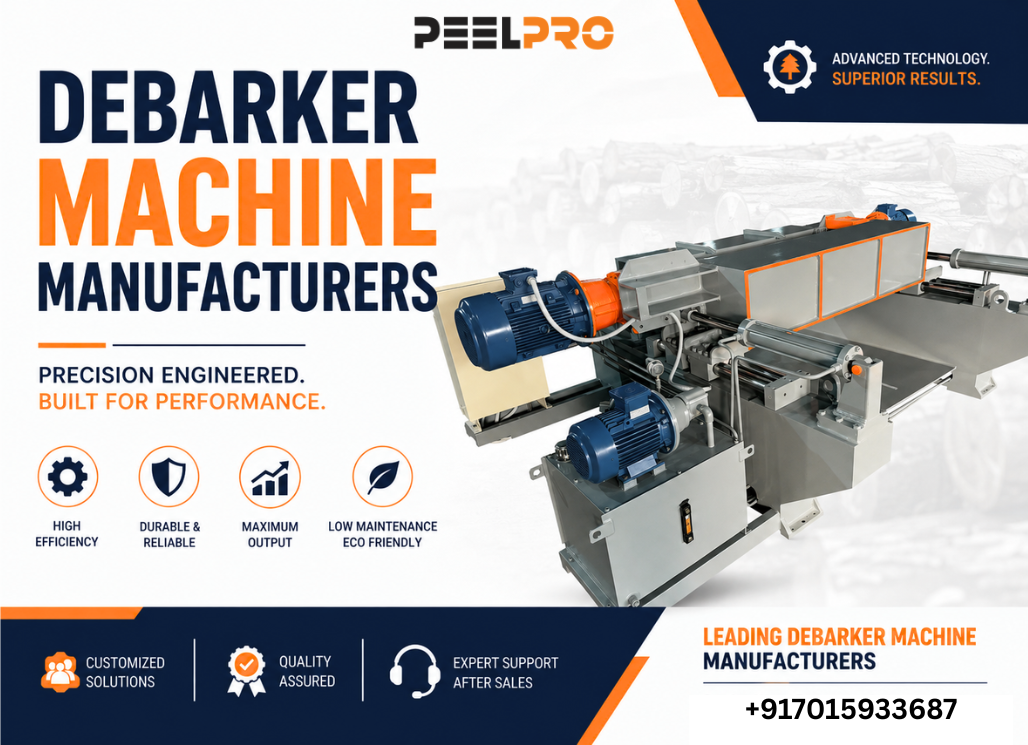
Debarking is an important step before the log enters the peeling process. A log debarker removes bark and helps prepare the outer surface of the log for subsequent processing.
Proper log preparation can support smoother peeling operations and help reduce unnecessary wear on downstream equipment.
For plywood and veneer manufacturers, a suitable debarker should be selected according to the type, size, and density of the timber being processed.
Spindle Log Peeling Machines
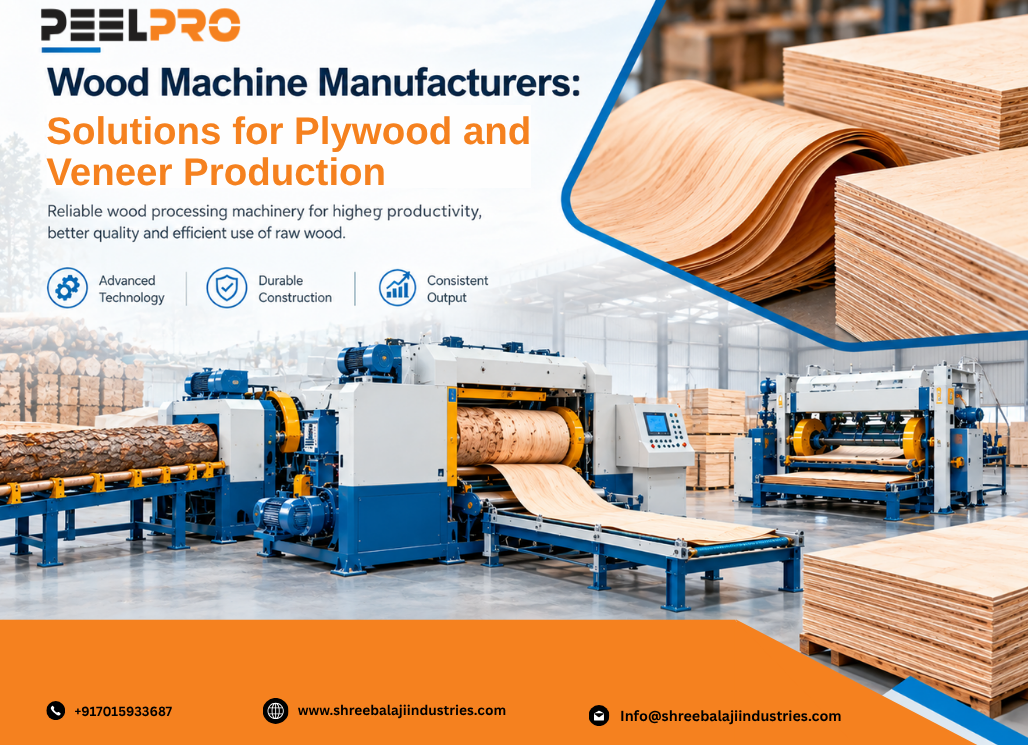
Spindle log peeling machines are designed to convert prepared logs into veneer sheets through controlled rotary peeling.
For example, the SPM-56 Spindle Log Peeling Machine from Shree Balaji Industries is designed to handle logs up to 1200 mm in diameter. It features an inbuilt veneer cutting system, PLC and HMI controls, variable speed, and a heavy-duty construction. The machine is specified for veneer thicknesses from 0.9 to 3.46 mm.
An integrated cutting system can help streamline the peeling and cutting stages while reducing additional manual handling.
Spindle-Less Log Peeling Machines
Spindle-less log peeling machines offer another option for veneer production and can be used for high-throughput plywood and veneer production since they are designed to peel logs without using conventional spindle arrangements.
Shree Balaji Industries offers the SLM-125-16 Spindle-Less Log Peeling Machine, which includes an inbuilt cutting system and is designed for precision peeling down to a small core diameter.
For manufacturers, spindle-less technology can be particularly useful when the goal is to improve log utilization and maintain consistent veneer production.
Benefits of Modern Wood Processing Machinery
Investing in appropriate machinery can provide several advantages for plywood and veneer manufacturers.
1. Better Production Efficiency
Automated and mechanically controlled equipment can process logs more consistently than highly manual operations, helping manufacturers manage larger production requirements.
2. Consistent Veneer Quality
Controlled peeling and cutting can help maintain more consistent veneer dimensions, which is important when producing plywood.
3. Better Raw Material Utilization
Efficient peeling can help manufacturers recover more usable veneer from individual logs. Better material utilization can also help reduce avoidable wood wastage.
4. Reduced Manual Handling
Features such as integrated cutting systems and automated controls can reduce repetitive manual operations and support a smoother production workflow.
5. Suitable for Industrial Production
Heavy-duty machinery is designed to operate under demanding industrial conditions. The appropriate machine can help businesses maintain production performance over extended operating periods.
How to Choose the Right Wood Machine Manufacturer
Choosing a machinery manufacturer involves more than comparing the initial purchase price. Businesses should consider how well the machine matches their production requirements and the level of support available after installation.
Here are some factors worth considering:
Machine Capacity
Check the maximum log diameter, veneer thickness range, processing speed, and overall production capacity.
Machine Construction
Industrial wood-processing machines need robust construction and reliable components to handle continuous production requirements.
Control System
PLC and HMI-based control systems can provide greater control over machine operations and production parameters.
Raw Material Compatibility
The machine should be suitable for the types of timber being processed, including the required range of softwoods and hardwoods.
Maintenance and Spare Parts
Availability of technical support, replacement components, and maintenance assistance can help reduce unexpected downtime.
Customization
Different plywood manufacturers may have different production layouts and requirements. A manufacturer capable of developing customized machinery can help businesses create a solution that fits their specific operation.
Why Work With an Experienced Wood Machinery Manufacturer?
An experienced manufacturer can give great advice when it comes to purchasing machines for a plywood or veneer production unit. Instead of focusing on the characteristics of individual machines, manufacturers can look at how different machines can be integrated into the production process.
Shree Balaji Industries has been dealing in wood processing machines since 2015 and describes itself as a manufacturer and supplier based in Yamunanagar, Haryana. The company’s machinery portfolio consists of spindle-less log peeling machines, spindle log peeling machines, log debarkers, and custom-made plywood machinery.
The company operates under the PeelPro brand and states that its machinery is developed for plywood and woodworking applications, with a focus on engineering, durability, testing, and customized solutions.
Shree Balaji Industries: Wood Processing Machinery for Plywood Production
Shree Balaji Industries provides machinery designed around the requirements of plywood and veneer production.
Its product range includes:
- Spindle Log Peeling Machines
- Spindle-Less Log Peeling Machines
- Log Debarker Machines
- Veneer Peeling Machinery
- Customized Plywood Machinery
The combination of log preparation and veneer peeling equipment allows manufacturers to consider different stages of the production process when planning their machinery requirements.
Making the Right Machinery Investment
Every plywood manufacturing unit has different requirements. A machine suitable for one production facility may not necessarily be suitable for another.
Before purchasing wood processing machinery, manufacturers should evaluate:
- Average and maximum log diameter
- Timber species and density
- Required veneer thickness
- Expected production volume
- Available factory space
- Automation requirements
- Power requirements
- Maintenance needs
- Technical support
- Future production expansion
Taking these factors into account can help businesses choose machinery that supports both current production and future requirements.
Conclusion
The quality and efficiency of plywood and veneer production depend heavily on the machinery used throughout the process. From log debarking and preparation to spindle or spindle-less log peeling, the right equipment can help manufacturers improve productivity, maintain veneer consistency, and make better use of raw materials.
For businesses searching for reliable wood machine manufacturers, it is important to evaluate machine specifications, construction, control systems, production capacity, maintenance support, and customization options.
Shree Balaji Industries, through its PeelPro range, offers wood-processing machinery for plywood and veneer applications, including spindle log peeling machines, spindle-less log peeling machines, and log debarker machines. With machinery focused on industrial wood processing and customized plywood requirements, the company provides solutions for manufacturers looking to develop or improve their production setup.